
More Than a Typing Skill: Why Recognising Touch Typing Through an Ofqual Qualification Matters
A valuable digital skill deserves more than a certificate of completion. It deserves national recognition.
In today's increasingly digital world, students are expected to use computers confidently throughout their education and into their working lives. From completing homework and coursework to sitting examinations, writing university dissertations and applying for jobs, keyboard skills have become an essential part of everyday learning.
Yet, despite the importance of these skills, touch typing is often overlooked as an educational achievement. Students may spend years developing their ability to type, but how is that ability formally recognised? How can they demonstrate to schools, colleges, universities and future employers that they have genuinely mastered this important skill?
At KAZ Type, we believe that learning to touch type should be about more than simply improving speed. It should be about developing a lifelong skill, gaining confidence and having that achievement formally validated.
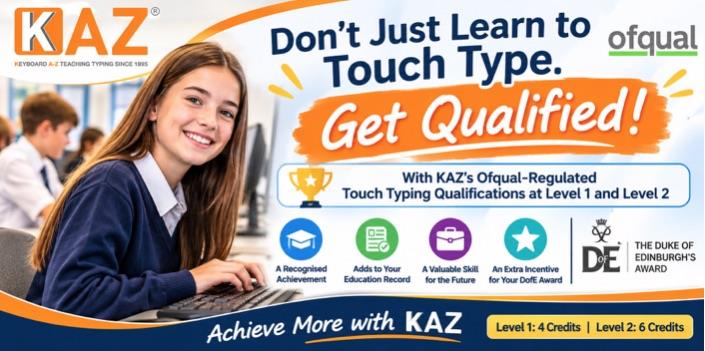
That is why, in partnership with Open Awards, KAZ offers nationally recognised, Ofqual-regulated qualifications in touch typing at Levels 1 and 2.
Why is validating touch typing so important?
There is a significant difference between being able to type and being able to demonstrate a recognised level of competency.
A student may have developed excellent keyboard skills through regular practise, but without an independently regulated assessment, there is no formal qualification to verify that ability.
The KAZ/Open Awards National Ofqual-regulated qualification changes this.
It provides an independently assessed and recognised measure of a student's practical typing ability and understanding of correct touch typing techniques. Rather than simply receiving a certificate for completing a course, learners must demonstrate that they have achieved specific standards.
This is important for several reasons:
1. A recognised achievement on the student's education record
Successfully completing an Ofqual-regulated qualification provides students with an additional, nationally recognised achievement.
Where a valid Unique Learner Number (ULN) has been provided, the qualification can be added to the learner's education record. This gives students something tangible to take forward as they progress through their education.
It also helps ensure that a practical digital skill, which can make a significant difference to a student's educational experience, is not overlooked.
2. An additional achievement for further education and employment
Touch typing is a transferable skill that students can use throughout their lives.
Being able to type accurately and efficiently can make a considerable difference when completing GCSE coursework, A-level assignments, college work, university dissertations and professional documentation.
For students moving into employment, a recognised qualification provides evidence of an additional practical skill that can support their CV and job applications.
It demonstrates commitment, independent learning and the ability to develop a skill that has genuine workplace relevance.
3. Recognising progress and building confidence
For some students, particularly those who find handwriting challenging, learning to touch type can be transformative.
It can reduce the physical effort associated with writing, improve productivity and allow learners to concentrate more fully on their ideas rather than the mechanics of recording them.
For neurodivergent learners, including those with dyslexia, dyspraxia, dysgraphia and other additional learning needs, touch typing can provide an alternative and more accessible way of expressing their knowledge.
Achieving a nationally recognised qualification gives these students an opportunity to celebrate their progress and have their abilities formally acknowledged.
The KAZ Ofqual-regulated qualifications: Levels 1 and 2
Working in partnership with Open Awards, KAZ offers two nationally recognised qualifications:
Level 1 – Award in Touch Typing Skills (RQF): 4 credits.
Level 2 – Award in Touch Typing Skills (RQF): 6 credits.
Both qualifications assess practical keyboard proficiency alongside an understanding of correct typing techniques and good computer workstation practices.
Learners complete two assessments:
Theory assessment: Testing knowledge of touch typing, posture and safe working practices, with additional workstation-related content at Level 2.
Practical assessment: A three-minute typing test measuring speed and accuracy.
The required practical standards are:
Candidates must also achieve the required pass mark in each theory assessment category.
Importantly, the qualification is not exclusive to learners using KAZ software. Students who have learned to touch type using another programme can choose the Assessment Only option and have their existing skills independently assessed.
This means that schools do not have to change their existing typing provision to give students the opportunity to gain a nationally recognised qualification.
An additional incentive for students completing their Duke of Edinburgh's Award
One particularly valuable application of the qualification is its connection with the Duke of Edinburgh's Award (DofE).
KAZ Type is an approved DofE Activity Skills Provider, offering young people the opportunity to learn touch typing as part of their Bronze, Silver or Gold Award.
The DofE encourages young people to develop new interests, practical abilities and personal skills. Touch typing fits naturally into this objective, providing a modern-day skill that can benefit participants throughout their education and beyond.
But why stop at learning the skill?
Through KAZ, participants can also work towards an optional Ofqual-regulated qualification, giving them an additional achievement to work towards alongside completing their DofE Skills section.
The structure offers:
Bronze and Silver: A 12-week touch typing programme, with the option of the Level 1 qualification (4 credits).
Gold: A six-month programme, with the option of the Level 2 qualification (6 credits).
Participants receive structured guidance, progress monitoring and support from KAZ assessors. On completion, their DofE assessor report is submitted through the eDofE process.
For students, this creates an excellent incentive. They are not simply spending time learning to type; they are developing a valuable lifelong skill while working towards a nationally recognised qualification that can also be recorded as part of their educational achievements.
It gives them something extra to celebrate and something meaningful to include in their future applications.
Why schools should take notice
Schools are continually looking for ways to recognise achievement, improve digital readiness and equip students with the skills they need beyond the classroom.
A touch typing qualification offers an opportunity to do all three.
It provides:
It also gives schools a way to recognise an achievement that is relevant to virtually every subject and every future career.
For students who struggle with handwriting, the opportunity can be particularly meaningful. A learner who has found written work challenging may discover that, with the right training, they can communicate their ideas more efficiently and independently using a keyboard. Having that ability formally recognised is an achievement worth celebrating.
A skill for life. A qualification for the future.
At KAZ Type, we have always believed that touch typing is much more than a computer skill. It is an investment in a student's independence, confidence and future opportunities.
Our partnership with Open Awards brings an important additional dimension to that learning: the opportunity to have the skill independently assessed, nationally recognised and recorded as an educational achievement.
Whether a student is preparing for GCSEs, progressing to college or university, participating in the Duke of Edinburgh's Award or preparing for employment, the benefits of touch typing extend far beyond the classroom.
We believe that skills which make such a difference to a student's future deserve to be recognised.
Don't just learn to touch type. Prove it. Achieve it. Add it to your education record.
Find out more about KAZ's Ofqual-regulated Touch Typing Qualifications:
https://kaz-type.com/products/openawards-ofqual-regulated-qualification
Discover KAZ's Duke of Edinburgh's Award courses:
https://kaz-type.com/duke-of-edinburgh-bronze-silver-gold-award
Don't just learn to Touch Type. Get Qualified!
Copyright KAZ Type Limited 2025. KAZ is a registered trade mark of KAZ Type Limited.
Developed by : STERNIC Pvt. Ltd.

 Course Login