
In the rapidly evolving landscape of digital education, a quiet compromise has taken root. As schools, universities, and independent learners increasingly rely on web-based platforms, digital textbooks, and educational databases, a familiar monetisation framework has followed: paid third-party advertising.
On paper, the logic seems practical. Ad revenue offsets development costs, lowers the barrier to entry for lower-income students, and creates sustainable software business models. However, when we look through the lenses of cognitive science, developmental psychology, and user experience design, this compromise reveals an invisible tax. Integrating commercial advertisements directly into the learning environment breaks the fundamental contract of education. The plain truth is that paid advertising is systematically counterproductive to learning.
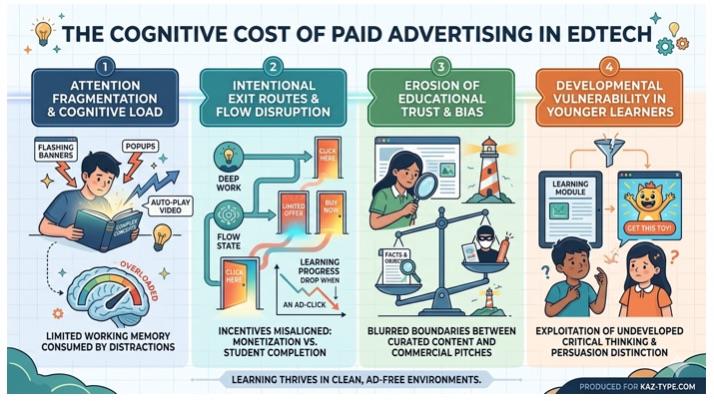
1. The Cognitive Load Problem: Splitting Limited Attention
To understand why advertising undermines education, we must first look at how the human brain processes new information. According to Cognitive Load Theory, our working memory has an exceptionally strict bottleneck. Unlike our long-term memory, which is virtually limitless, working memory can only hold a few pieces of information at a time.
When a student is attempting to learn a difficult concept—such as balancing a chemical equation or mastering a physical skill like touch typing—their working memory is already operating at or near maximum capacity. This essential processing demand is known as germane cognitive load.
Every time a flashing banner, an animated sidebar, or a recommended content widget appears on the screen, it introduces heavy extraneous cognitive load. Advertisements are engineered by sophisticated algorithms to trigger our involuntary "orienting response"—the primitive psychological mechanism that compels us to attend to sudden changes in our visual environment. When a student is forced to constantly suppress these micro-distractions, valuable mental energy is burned simply by ignoring the noise, leaving fewer cognitive resources available to actually master the material.
2. Deep Focus vs. Hypertext Disruption
True academic progress relies heavily on deep work and sustained concentration. When a student reads print media, their interaction path is linear and continuous. In contrast, modern digital spaces with programmatic advertising introduce a chaotic ecosystem of hyper-stimulating off-ramps.
Paid ads function as intentional exit routes from the educational flow. If a platform's revenue increases with the number of users who click away from its pages via ads, the site's economic incentives are perfectly misaligned with the student's primary objective: to stay on the page and finish the lesson. The digital environment becomes a psychological battlefield between the student's willpower and the advertiser's optimisation tools.
3. The Erosion of Educational Trust
The relationship between a student and an educational resource is built entirely on trust. Content in a digital curriculum is expected to be curated, accurate, objective, and intended solely for intellectual growth. Paid advertising, particularly native advertising—which mimics the visual style of the host website's articles and tools—deeply blurs these boundaries.
When an informational platform pivots seamlessly into a commercial pitch, it compromises the authority of the material. Students, particularly adult learners looking for credible references, are forced to filter out commercial bias. Instead of evaluating facts on their merits, they must constantly double-check whether a given resource is genuinely informative or just a highly optimised marketing funnel.
4. Developmental Vulnerabilities in Younger Learners
While adults can consciously identify and criticise digital marketing, younger learners are at a significant disadvantage. Developmental psychology indicates that children under the age of eight often struggle to differentiate between informational content and persuasive commercial messaging.
When an educational tool mandated by a school system serves targeted ads, it exploits this developmental vulnerability. Children process these ads with the same lack of scepticism that they apply to their school assignments. This turns an environment that should foster critical thinking into a space that cultivates uncritical consumerism.
Comparing Divergent Design Missions
Conclusion: Building Better Classrooms
For digital education to fulfil its revolutionary potential, it must respect the architecture of the human mind. Just as we would never allow commercial billboard operators to plaster the walls of a physical classroom with targeted promotions, we must stop accepting paid ad networks as a standard design pattern in virtual learning environments.
Moving forward, EdTech developers, school administrators, and digital content creators must actively explore healthier alternatives. Subscription models, institutional licensing, philanthropic backing, and public grants can provide the necessary revenue without compromising the educational interface.
Platforms like kaz-type.com demonstrate that prioritising an entirely ad-free environment is not just an ethical choice, but a pedagogical necessity. By keeping digital learning platforms clean, we protect our students' attention, respect their cognitive bandwidth, and preserve the ultimate integrity of the digital classroom.
Copyright KAZ Type Limited 2025. KAZ is a registered trade mark of KAZ Type Limited.
Developed by : STERNIC Pvt. Ltd.

 Course Login