
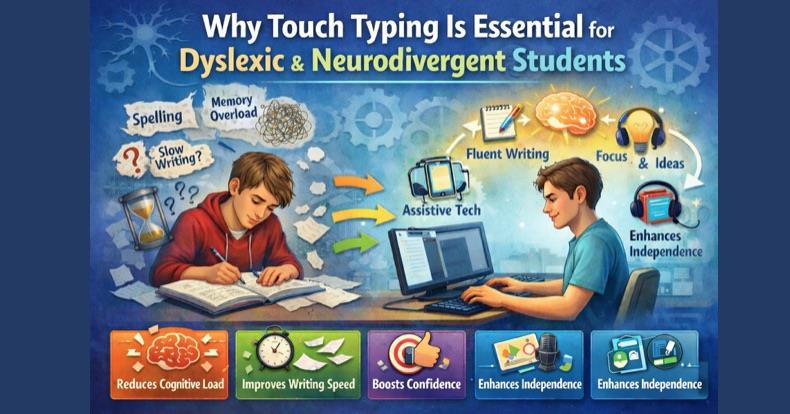
For many dyslexic and neurodivergent students, the physical act of writing or typing can present a significant barrier to learning. Touch typing is therefore not simply a productivity skill; it is an important accessibility tool that enables students to communicate their knowledge without being limited by the mechanics of written output.
Students with dyslexia, dyspraxia, ADHD, dysgraphia, and other neurodivergent profiles often experience difficulties with spelling, sequencing, working memory, and motor coordination. When these students type by looking down at the keyboard and searching for each letter individually, their attention is divided between multiple tasks: finding the correct key, remembering the word they wish to write, maintaining the structure of their sentence, and organising their ideas. This places a heavy load on working memory and frequently disrupts the flow of thought.
Touch typing helps to remove this barrier by developing automatic keyboard skills through muscle memory. Once key locations become automatic, students no longer need to visually search for letters. This allows them to keep their eyes on the screen and maintain focus on language, ideas, and structure rather than the physical process of typing. As a result, many dyslexic students find that they can express their thoughts more fluently and produce written work more efficiently.
Touch typing also supports the use of assistive technologies that are commonly recommended for neurodivergent learners. Tools such as speech-to-text, predictive spelling software, mind-mapping tools, and screen readers all rely heavily on efficient keyboard interaction. Students who can confidently navigate the keyboard are able to use these technologies more effectively, improving both productivity and independence.
In addition, touch typing can reduce frustration and anxiety around written work. Many dyslexic and neurodivergent students experience a gap between their verbal ability and their written output. When typing is slow or effortful, this gap becomes more pronounced and can negatively affect confidence and motivation. Developing touch-typing skills helps close this gap by allowing students to capture ideas at a speed closer to their thinking.
For these reasons, structured touch-typing training should be considered a valuable intervention within the Disabled Students’ Allowance (DSA) support framework. By helping dyslexic and neurodivergent students develop automatic keyboard skills, assessors can remove a key barrier to written communication and enable students to demonstrate their true academic potential.
Copyright KAZ Type Limited 2025. KAZ is a registered trade mark of KAZ Type Limited.
Developed by : STERNIC Pvt. Ltd.

 Course Login